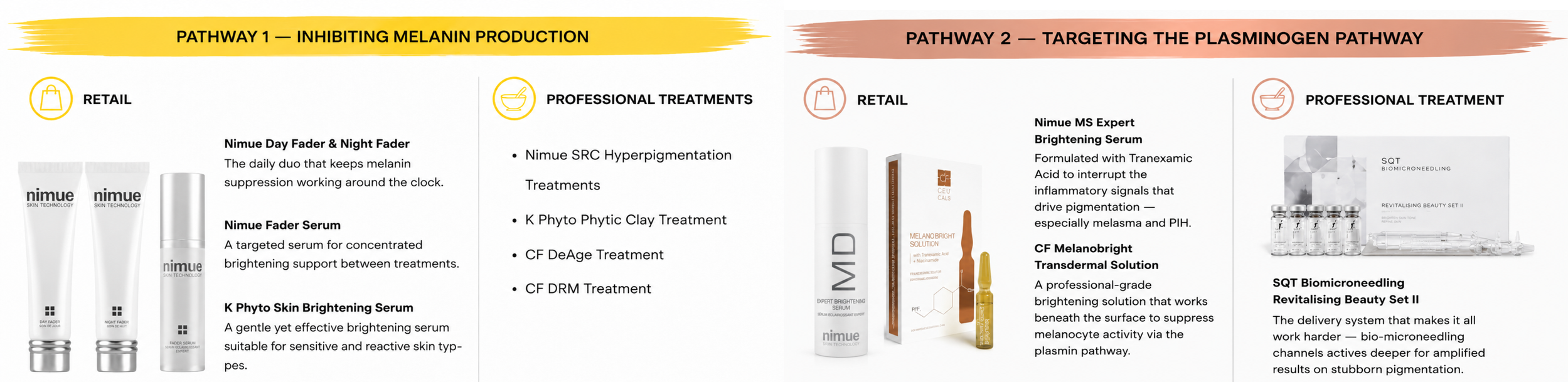
Why your hyperpigmentation treatments aren't sticking

Make it stand out
This leads to frustration for both the client and the therapist. Confusion over which treatment and product is going to deliver. Loss of faith in the process. Less follow through from client.
This is because there are TWO pathways of stimulation that are happening in the background. If you are only targeting one then you will fail to see long term results with stubborn hyperpigmentation.
Pathway 1:
The one we all focus on – the stimulation of melanogenesis through the tyrosinase pathway. Is the process of melanin production by melanocytes, primarily stimulated by UV radiation (UVB/UVA), triggering melanocyte stimulating hormone (a-MSH) and various chemical compounds, Key signalling pathways, such as cAMP/PKA/CREB and MAPK/ERK, are activated to upregulate MITF, the master transcription factor for enzymes like tyrosinase, enhancing pigment production and transfer to the keratinocytes to act as a protective mechanism from subsequent DNA Damage due to UV radiation.
Pathway 2:
The plasminogen/plasmin pathway is a crucial, non-tyrosinase-dependent mechanism in the formation of hyperpigmentation, particularly in conditions like melasma and post-inflammatory hyperpigmentation (PIH) It acts as a bridge between skin inflammation/injury and melanocyte activation, where plasmin stimulates melanin production in the basal layer of the epidermis.
We achieve long term results for clients seeking an answer to their stubborn hyperpigmentation by using sophisticated tyrosinase inhibitors to inhibit pathway 1 and Tranexamic acid to reduce the effects of pathway 2.
Tranexamic acid, commonly used in treating melasma, acts as a plasmin inhibitor. It reduces plasminogen binding, lowering the plasmin level in the skin. This in turn reduces melanocyte proliferation and reduces the interaction between keratinocytes and melanocytes that drives hyperpigmentation.
Action –
Mechanism: It binds to plasminogen, preventing its conversion to plasmin
Result: By blocking plasmin, it interrupts the interaction between keratinocytes and melanocytes, reducing inflammation and suppressing the melanogenesis that leads to melasma
Why liver health matters too
The plasminogen activation system (PAS) is primarily responsible for the degradation of fibrin clots as well as extracellular matrix remodeling. Many components of the PAS are produced by the liver, and the expression of these proteins is altered during liver disease. The connection between the liver-produced plasminogen system and hyperpigmentation is primarily mediated through the effects of plasmin on keratinocytes and vascularity. The liver plays a primary role in the synthesis of plasminogen and other PAS components, including uPA (urokinase-type plasminogen activator) and tPA (tissue-type plasminogen activator), which are often altered during liver injury and repair.
Plasminogen activator (PA) and its resulting plasmin help regulate melanin production. Increased activity in this pathway can lead to excessive pigmentation.