
The Physiology of Acne: What Is Really Happening Beneath the Surface
Acne is one of the most emotionally loaded skin concerns a therapist will encounter in their career. Clients arrive frustrated, often after years of trying everything. They have been through pharmacy shelves, online recommendations and well-meaning advice from friends. By the time they sit in your treatment chair, many have lost confidence not just in their skin but in the possibility of things ever genuinely improving.
That weight matters. And it is precisely why understanding the true physiology of acne is so important. Because when you understand what is actually driving it, you stop chasing symptoms and start treating the condition.
It Starts With the Sebaceous Gland
Every acne lesion begins in the follicle. The sebaceous glands, which are most densely distributed across the face, chest and back, produce sebum as a natural protective mechanism for the skin. Under normal conditions, sebum travels up through the follicular canal and onto the skin surface, where it forms part of the skin's protective acid mantle.
The problem begins when that process is disrupted. In acne-prone skin, a combination of factors causes the follicular canal to become obstructed. Excess sebum production, driven largely by androgens, creates an environment where the natural flow is compromised. At the same time, abnormal keratinisation occurs within the follicle wall.
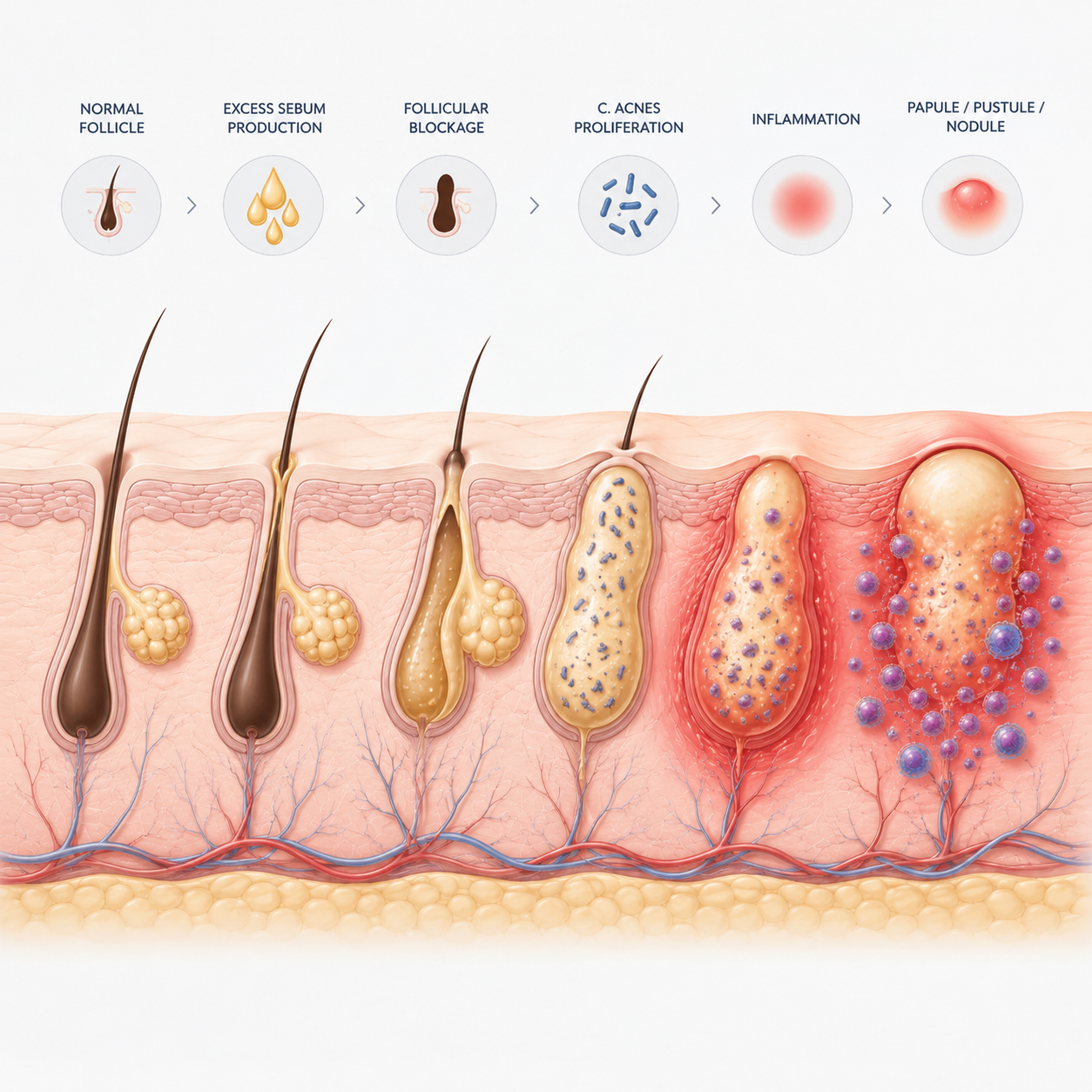
Instead of shedding normally, keratinocytes become sticky and begin to accumulate, forming a plug that traps sebum, dead skin cells and bacteria within the follicle. This is the microcomedo, the starting point of virtually every acne lesion, and it forms long before anything is visible on the skin surface.
The Role of Cutibacterium Acnes
Within the sebum-rich, low-oxygen environment of a blocked follicle, Cutibacterium acnes, formerly known as Propionibacterium acnes, thrives. This gram-positive bacterium is a natural resident of the skin microbiome and in a balanced state causes no harm. But in the anaerobic conditions created by a blocked follicle, it proliferates rapidly. As C. acnes multiplies, it metabolises sebum and releases free fatty acids and other byproducts that trigger an innate immune response. The body recognises these byproducts as a threat and sends inflammatory mediators to the area.
This is where acne transitions from a simple blockage into something far more complex. The inflammatory cascade that follows is what determines whether a client develops a whitehead, a papule, a pustule or, in more severe cases, a nodule or cyst. The depth and intensity of that inflammatory response varies between individuals, which is why two clients with seemingly similar skin can have dramatically different acne presentations.
Inflammation Is Not the Enemy
This is an important distinction for therapists to understand. Inflammation in acne is not the problem. It is the body's attempt to solve a problem. The issue is when that inflammatory response becomes chronic, excessive or poorly resolved, causing collateral damage to surrounding tissue that eventually manifests as post-inflammatory hyperpigmentation, scarring and impaired barrier function.
Clients who pick, squeeze or over-strip their skin are essentially amplifying this inflammatory response. They are introducing additional trauma to a follicular environment that is already under stress, which is why education around home behaviour is just as critical as the treatment protocol itself.
The Barrier Connection
Something that is frequently overlooked in acne management is the role of the skin barrier. Many acne-prone clients present with a compromised barrier, often made worse by years of harsh cleansing, over-exfoliation or the use of drying topical treatments.
A compromised barrier increases transepidermal water loss, reduces the skin's ability to regulate microbial populations and creates a state of chronic low-grade inflammation that perpetuates the acne cycle. This is why a purely aggressive approach to acne treatment often backfires. Stripping and drying the skin may temporarily reduce surface oil, but it rarely resolves the underlying condition and frequently makes things worse over time.
Effective acne management requires a treatment approach that can simultaneously address congestion, bacterial proliferation, inflammation and barrier integrity. That is a complex brief, and it requires professional solutions that are genuinely up to the task.
Treating the Whole Picture
At Grace Beauty, we have built a professional acne portfolio that allows therapists to treat acne at every stage of the journey, from active breakouts through to post-acne repair, scarring and pigmentation. The Nimue Purifier range provides the daily homecare foundation that acne management depends on. Formulated specifically for oily, congested and blemish-prone skin, the Purifier range supports the skin's acid mantle, manages sebaceous activity and maintains a balanced microbiome without compromising barrier integrity. Consistent homecare is non-negotiable in acne management, and the Purifier range gives clients a regimen they can trust.
The Nimue SRC Problematic Treatment is a targeted in-clinic keratolytic peeling system designed specifically for congested, acne-prone skin. It works by addressing the abnormal keratinisation within the follicle that drives comedone formation, while simultaneously managing sebaceous activity and supporting skin renewal. For clients with active congestion and blemish-prone skin, this is a highly effective clinical solution that delivers visible results progressively over a treatment series.
The SQT Resurfacing Repair Set brings bio-microneedling into the acne treatment conversation in a way that genuinely changes outcomes. Using 99% hydrolysed siliceous spicule technology, SQT creates millions of microchannels in the skin that stimulate accelerated cell turnover, improve product penetration and trigger the wound healing response. For post-acne scarring, enlarged pores, textural irregularities and post-inflammatory marks, this treatment offers a level of skin renewal that is difficult to achieve through conventional peeling alone.
The SQT Refine Spicule Serum extends the benefits of spicule technology into a homecare format specifically designed for oily, combination and blemish-prone skin. Powered by spicule technology and targeted actives, it minimises pores, balances oil production and improves overall skin texture between professional treatments. It is a genuinely exciting addition to the acne retail conversation because it gives clients an active, results-driven product that complements and extends what you are doing in the treatment room.
The Emotional Weight of This Work
It is worth pausing here to acknowledge something that clinical language does not always capture. Acne affects people deeply. It affects how they show up in the world, how they feel walking into a room, how comfortable they are in their own skin. The clients sitting across from you are not just looking for a clearer complexion. They are looking for confidence, for relief, for someone who finally understands what they have been dealing with.
When you combine a genuine understanding of the physiology with the right professional tools, you are not just treating a skin condition. You are giving someone their confidence back. That is the real value of this work, and it is why getting the science right matters so much.
Where to Start
If acne management is an area you want to develop further in your clinic, we would love to support you. Whether that means reviewing your current treatment protocols, introducing bio-microneedling, or building a more comprehensive retail offering around the acne journey, the Grace Beauty team is here to help.
The physiology is complex. The treatment pathway does not have to be.